
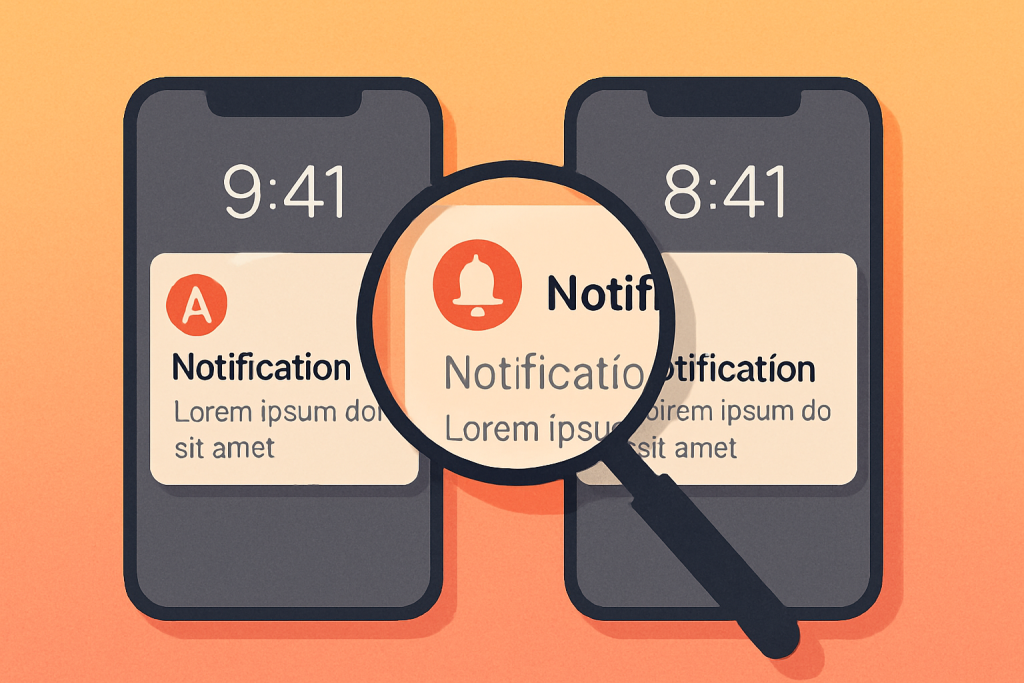
In the fast-paced world of e-commerce, standing out from the crowd and capturing your audience’s attention is more critical than ever. Push notifications are a powerful tool for engaging customers, driving traffic, and boosting sales. But are your push notifications performing as well as they could be? The key to unlocking their full potential lies in a simple yet effective strategy: A/B testing.
What is A/B Testing and Why is it Important?
A/B testing, also known as split testing, is a method of comparing two versions of something to see which one performs better. In the context of push notifications, it involves sending two slightly different versions of a notification to different segments of your audience and then analyzing which version achieves the desired outcome, such as higher click-through rates, conversions, or engagement.
Why is A/B testing important for e-commerce businesses?
- Optimizes performance: It allows you to refine your push notification strategy based on real data, leading to improved results.
- Reduces guesswork: Instead of relying on assumptions, you can make informed decisions about what resonates with your audience.
- Increases ROI: By sending more effective notifications, you can drive more traffic, sales, and customer loyalty, ultimately boosting your return on investment.
- Enhances customer experience: A/B testing helps you understand your audience’s preferences, allowing you to tailor your messaging and provide a more personalized experience.
Failing to A/B test your push notifications is like navigating in the dark. You might reach your destination eventually, but you’ll likely take a longer, more circuitous route and miss out on valuable opportunities along the way. Embrace A/B testing, and you’ll be well on your way to push notification success.
What Elements Can You Test in Your Push Notifications?
The beauty of A/B testing lies in its versatility. You can test a wide range of elements within your push notifications to see what resonates best with your audience. Here are some key areas to focus on:
Headline Copy
The headline is the first thing your audience sees, so it needs to grab their attention and entice them to click. Experiment with different approaches, such as:
- Urgency: “Limited-time offer ends tonight!”
- Intrigue: “You won’t believe what’s on sale!”
- Benefit-driven: “Save 20% on your next order!”
- Personalization: “[Name], check out these new arrivals!”
Body Text
The body text provides more details about your offer or message. Test different lengths, tones, and content to see what drives the most engagement:
- Conciseness: Shorter, punchier messages vs. longer, more detailed descriptions.
- Tone of voice: Formal vs. informal, playful vs. serious.
- Value proposition: Highlight the key benefits of your product or offer.
Call to Action
Your call to action (CTA) should be clear, compelling, and tell your audience exactly what you want them to do. Test different CTAs to see which ones generate the most clicks:
- “Shop Now”
- “Learn More”
- “Claim Your Discount”
- “View Deal”
Delivery Time
The timing of your push notifications can significantly impact their performance. Experiment with different delivery times to find the optimal window for your audience:
- Time of day: Morning, afternoon, evening, or late night.
- Day of the week: Weekdays vs. weekends.
- Time zones: Ensure you’re sending notifications at appropriate times for your audience’s location.
How to Set Up and Run Effective A/B Tests
Running successful A/B tests requires careful planning and execution. Here’s a step-by-step guide to get you started:
- Define your goals: What do you want to achieve with your push notifications? (e.g., increase click-through rates, drive sales, boost app engagement).
- Choose your metric: What metric will you use to measure the success of your tests? (e.g., click-through rate, conversion rate, open rate).
- Identify your variables: What elements of your push notifications do you want to test? (e.g., headline, body text, CTA).
- Create your variations: Develop two or more versions of your push notification, each with a slight variation of the element you’re testing.
- Segment your audience: Divide your audience into two or more equal groups, ensuring that each group is representative of your overall customer base.
- Run your test: Send each variation of your push notification to a different segment of your audience and track the results.
- Analyze your results: After a sufficient amount of time has passed, analyze the data to see which variation performed better.
- Implement the winning variation: Once you’ve identified the winning variation, implement it for all future push notifications.
Pushloop can significantly simplify the A/B testing process. While Pushloop doesn’t directly manage A/B testing natively, its robust segmentation and automation capabilities allow you to easily create and target different notification versions to specific audience segments. This allows for effective A/B testing using the platform’s built-in analytics to track performance and identify winning strategies.
Analyzing Your Results and Making Data-Driven Decisions
Once you’ve run your A/B tests, it’s crucial to analyze the results carefully and make data-driven decisions. Look beyond the surface-level metrics and dig deeper to understand why certain variations performed better than others.
Consider the following:
- Statistical significance: Ensure that the results are statistically significant, meaning that the difference in performance between the variations is not due to chance.
- Audience segmentation: Did certain variations perform better with specific audience segments? This could indicate the need for more personalized messaging.
- Contextual factors: Were there any external factors that may have influenced the results? (e.g., a major holiday, a competitor’s promotion).
By analyzing your A/B testing results, you can gain valuable insights into your audience’s preferences and optimize your push notification strategy for maximum impact. Remember that A/B testing is an iterative process. Continuously test and refine your approach to stay ahead of the curve and deliver the most engaging and effective push notifications possible.
Conclusion
A/B testing is an indispensable tool for any e-commerce business looking to maximize the effectiveness of its push notifications. By systematically testing different elements and analyzing the results, you can gain valuable insights into your audience’s preferences and optimize your messaging for improved engagement, conversions, and customer loyalty. Stop guessing and start testing – your push notification success depends on it!

